Mozzarella Nutrition Facts: Calories, Vitamins & Minerals
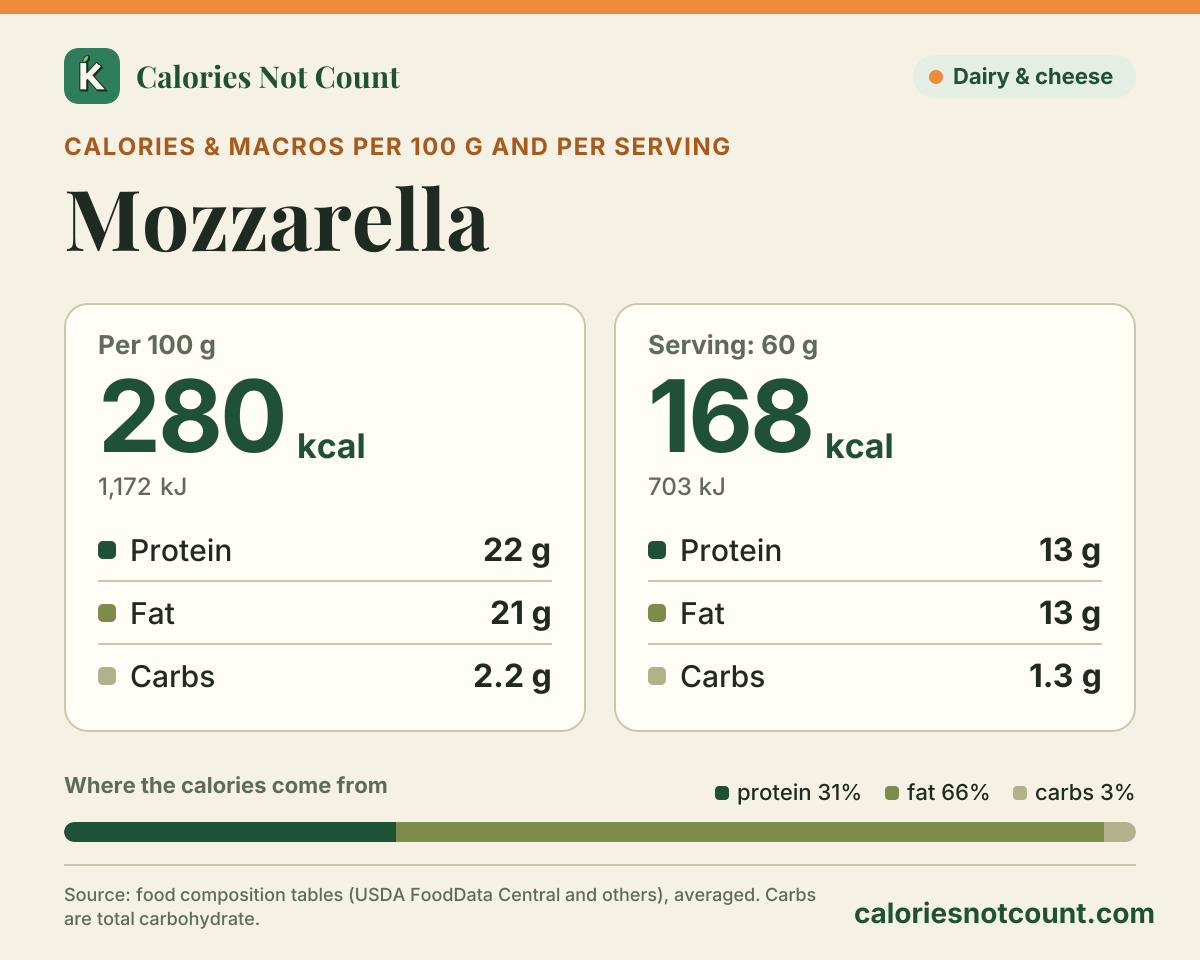
Mozzarella nutrition facts per 100 g and per serving
| Nutrient | Per 100 g | Serving: 60 g |
|---|---|---|
| Calories | 280 kcal | 168 kcal |
| Energy (kilojoules) | 1,172 kJ | 703 kJ |
| Protein | 22 g | 13 g |
| Fat | 21 g | 13 g |
| incl. saturated | 13 g | 7.8 g |
| Total carbohydrates | 2.2 g | 1.3 g |
| incl. sugars | 1 g | 0.6 g |
| incl. fiber | 0 g | 0 g |
| Salt | 1.4 g | 0.8 g |
*Where the numbers come from
Values per 100 g as eaten, averaged from food composition tables (USDA FoodData Central and others) and rounded — a specific brand or recipe will differ a little. Carbohydrates are total carbohydrate, fiber included, as on a US Nutrition Facts label.
280 kcal (1,172 kJ) per 100 g · P/F/C 22/21/2.2 g
Serving (60 g) — 168 kcal (703 kJ) · Nutri-Score D
Per 100 g: sugar: low saturated fat: high salt: medium fiber: low
Is mozzarella healthy?
Only in small amounts, and not every day. Mozzarella gets grade D on the open 2023 Nutri-Score algorithm, the second-lowest of five.
For
- Protein: 13 g per serving — 23% of the 56 g daily reference for a 70 kg (154 lb) adult.
Against
- Saturated fat: 7.8 g per serving — 39% of the 20 g daily reference intake.
A typical serving is 60 g: 168 kcal, 13 g protein, 13 g fat and 1.3 g carbs. Other weights in the table.
How we judge this, and the sources
The answer comes from the food's composition, not from opinion: its Nutri-Score grade on the open 2023 algorithm, a traffic light for sugar, salt, saturated fat and fiber per 100 g, and the share of daily reference amounts in a typical serving (for salt, sugar, fiber and vegetables, those of the WHO). It rates the food's nutrient profile; it is not medical advice. Formulas, thresholds and every source are on the methodology page; last checked against the sources on November 1, 2026. The short food description was written by our language model (AI) — how we check the text.
More about this food
Mozzarella is a fresh, soft cheese with less salt and fat than aged hard cheeses and a decent amount of protein.
protein 31%fat 66%carbs 3%
Vitamins and minerals in mozzarella
Per 100 g, the standouts are vitamin B12 — 2.3 mcg, 95% of the Daily Value (#1 of 10 in our dairy & cheese section); calcium — 505 mg, 39% of the Daily Value; selenium — 17 mcg, 31% of the Daily Value.
| Nutrient | Per 100 g | Serving: 60 g | % DV |
|---|---|---|---|
| Vitamin A | 179 mcg | 107 mcg | 12% |
| Vitamin D | 0.4 mcg | 0.24 mcg | 1% |
| Thiamin (B1) | 0.03 mg | 0.02 mg | 2% |
| Riboflavin (B2) | 0.28 mg | 0.17 mg | 13% |
| Vitamin B6 | 0.04 mg | 0.02 mg | 1% |
| Vitamin B12 | 2.3 mcg | 1.4 mcg | 57% |
| Calcium | 505 mg | 303 mg | 23% |
| Magnesium | 20 mg | 12 mg | 3% |
| Phosphorus | 354 mg | 212 mg | 17% |
| Iron | 0.44 mg | 0.26 mg | 1% |
| Zinc | 2.9 mg | 1.8 mg | 16% |
| Selenium | 17 mcg | 10 mcg | 19% |
| Cholesterol | 79 mg | 47 mg | 16% |
*Where the vitamin numbers come from
Vitamins and minerals come from the USDA FoodData Central record “Cheese, mozzarella, whole milk” (FDC ID 170845, SR Legacy; public domain), checked October 14, 2026; the record was matched to this food by calories, protein and fat. % DV is per serving, against the FDA Daily Values used on Nutrition Facts labels (2,000-calorie diet). The table lists nutrients that reach at least 2% DV per 100 g; the rest are absent or trace. Varieties, seasons and brands differ, and cooking in water leaches some vitamin C and B vitamins.
Mozzarella calories by weight, 20–150 g
30 g of mozzarella has 84 calories and 50 g has 140. The table gives protein, fat and carbs for each weight; for any other amount, type your own into the calculator below.
| Weight | Kcal | P / F / C, g |
|---|---|---|
| 20 g | 56 | 4.4 / 4.2 / 0.4 |
| 30 g | 84 | 6.6 / 6.3 / 0.7 |
| 50 g | 140 | 11 / 11 / 1.1 |
| 60 g — typical serving | 168 | 13 / 13 / 1.3 |
| 100 g | 280 | 22 / 21 / 2.2 |
| 150 g | 420 | 33 / 32 / 3.3 |
Free to reuse with a link to the source, CC BY 4.0
Try it with your numbers
Portion → calories and macros
Pick a food and a portion.
Mozzarella: calories by type
“Calories per 100 g” depends on the kind: fat level, variety, what's added. Every row comes from the same database the diary uses.
| Per 100 g | Kcal | P / F / C, g |
|---|---|---|
| Mozzarella | 280 | 22 / 21 / 2.2 |
| Low-moisture mozzarella, grated | 300 | 24 / 22 / 2 |
Calories in dishes with mozzarella
| Dish | Serving | Kcal per serving | Mozzarella in it |
|---|---|---|---|
| Künefe | 180 g | 628 | ≈50 g |
| Mushroom quesadilla | 190 g | 433 | ≈50 g |
| Cheese naan | 120 g | 341 | ≈30 g |
| Pide with cheese and egg | 230 g | 587 | ≈51 g |
| Cheese quesadilla | 150 g | 489 | ≈30 g |
| Arancini with mozzarella | 320 g | 714 | ≈44 g |
| Ciabatta with chicken and sun-dried tomatoes | 230 g | 561 | ≈30 g |
| Gnocchi alla sorrentina | 320 g | 422 | ≈40 g |
How we count
Dishes are estimated from typical restaurant and home recipes — a specific kitchen will differ.
How much movement is one serving?
A 60 g serving is 168 kcal — roughly 55 min of easy walking or 21 min of cycling for a 70 kg (154 lb) person. In the diary, minutes are worked out for your weight and the activities you actually do.
Mozzarella: swaps and alternatives
Mozzarella has a lot of saturated fat (13 g per 100 g) and a fair amount of salt (1.4 g per 100 g), but our database has no same-category swap that fixes this noticeably at the same calories and is a full grade better. The simplest move is a smaller serving. How we pick swaps.
What to pair mozzarella with
A serving of mozzarella has no fiber (the WHO suggests at least 25 g a day); that's easy to make up on the same plate:
- Raspberries, 120 g — +4.4 g fiber, 55 kcal.
Similar foods with a better grade than mozzarella
Same food group, a better Nutri-Score grade. They fall short of a noticeable per-serving swap, but their profile is better. Figures are for 60 g, a typical serving of mozzarella.
| Food | Grade | Kcal | Protein, g | Fiber, g | Sat. fat, g |
|---|---|---|---|---|---|
| Mozzarella | D | 168 | 13 | 0 | 7.8 |
| Ricotta | C | 104 | 6.6 | 0 | 4.8 |
| Swiss Cheese (Emmental) | C | 238 | 18 | 0 | 13 |
Mozzarella vs similar foods: calories compared
| Per 100 g | Kcal | P / F / C, g |
|---|---|---|
| Feta | 264 | 14 / 21 / 4.1 |
| Mozzarella | 280 | 22 / 21 / 2.2 |
| Queso Fresco | 299 | 18 / 24 / 3 |
| Provolone | 340 | 26 / 27 / 0 |
| Cream Cheese | 342 | 6 / 34 / 4.1 |
| Heavy Cream | 360 | 2.1 / 38 / 3 |
| Parmesan | 392 | 36 / 26 / 3.2 |
FAQ
How many calories are in 100 g of mozzarella?
100 g of mozzarella has 280 calories, with 22 g protein, 21 g fat and 2.2 g carbohydrates.
How many calories are in a serving of mozzarella?
A 60 g serving has 168 calories: 13 g protein, 13 g fat and 1.3 g carbs.
What are the macros of mozzarella?
Per 100 g: 22 g protein, 2.2 g carbs and 21 g fat. By calories that's about 31% protein, 3% carbs and 66% fat.
How long do you have to walk to burn a serving of mozzarella?
About 55 min of easy walking or 21 min of cycling for a 70 kg (154 lb) person — that's the 168 calories in a 60 g serving.
What vitamins and minerals are in mozzarella?
Per 100 g, mozzarella is richest in vitamin B12 (2.3 mcg, 95% DV), calcium (505 mg, 39% DV), selenium (17 mcg, 31% DV) — from USDA FoodData Central record 170845.
How much fiber is in mozzarella?
None: dietary fiber comes from plant foods and mushrooms — vegetables, fruit, grains, beans and nuts.
More in dairy & cheese
CheddarButterOat MilkAlmond MilkSoy MilkSkyrWhole MilkSkim MilkMilkKefir