Garlic Nutrition Facts: Calories, Vitamins & Minerals
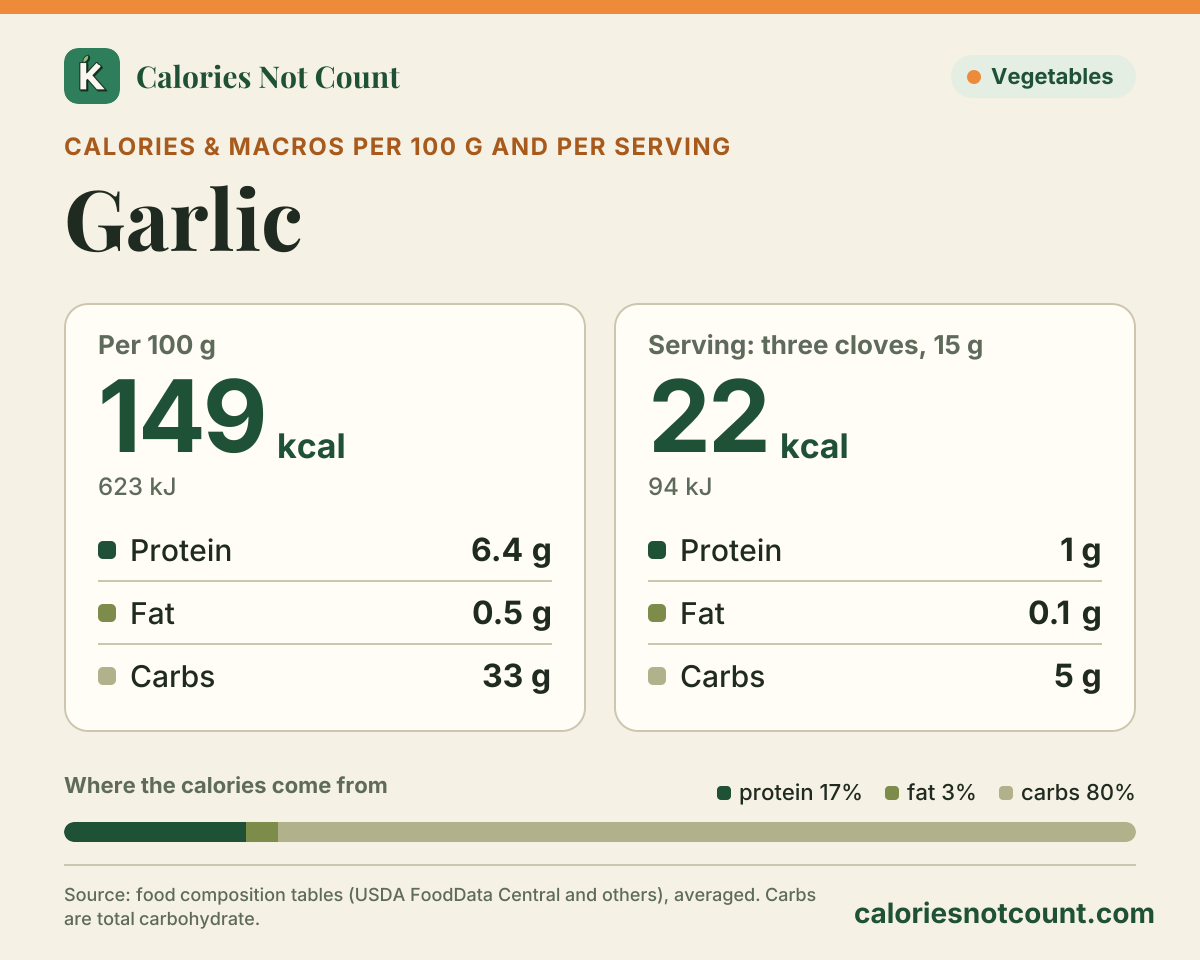
Garlic nutrition facts per 100 g and per serving
| Nutrient | Per 100 g | Serving: three cloves, 15 g |
|---|---|---|
| Calories | 149 kcal | 22 kcal |
| Energy (kilojoules) | 623 kJ | 94 kJ |
| Protein | 6.4 g | 1 g |
| Fat | 0.5 g | 0.1 g |
| incl. saturated | 0.1 g | 0 g |
| Total carbohydrates | 33 g | 5 g |
| incl. sugars | 1 g | 0.2 g |
| incl. fiber | 2.1 g | 0.3 g |
| Salt | 0 g | 0 g |
*Where the numbers come from
Values per 100 g as eaten, averaged from food composition tables (USDA FoodData Central and others) and rounded — a specific brand or recipe will differ a little. Carbohydrates are total carbohydrate, fiber included, as on a US Nutrition Facts label.
149 kcal (623 kJ) per 100 g · P/F/C 6.4/0.5/33 g
Serving (three cloves, 15 g) — 22 kcal (94 kJ) · Nutri-Score A
Per 100 g: sugar: low saturated fat: low salt: low fiber: low
Is garlic healthy?
Yes. On its nutrient profile, garlic is a healthy choice: grade A on the open 2023 Nutri-Score algorithm, the top grade.
For
- All green on the traffic light: 1 g sugar, 0 g salt and 0.1 g saturated fat per 100 g.
A typical serving (three cloves, 15 g) has 22 kcal, 1 g protein, 0.1 g fat and 5 g carbs. Other weights in the table.
How we judge this, and the sources
The answer comes from the food's composition, not from opinion: its Nutri-Score grade on the open 2023 algorithm, a traffic light for sugar, salt, saturated fat and fiber per 100 g, and the share of daily reference amounts in a typical serving (for salt, sugar, fiber and vegetables, those of the WHO). It rates the food's nutrient profile; it is not medical advice. Formulas, thresholds and every source are on the methodology page; last checked against the sources on November 1, 2026. The short food description was written by our language model (AI) — how we check the text.
More about this food
Garlic is eaten by the gram, so its main contribution is flavor. The smell comes from sulfur compounds formed when a clove is cut or crushed.
protein 17%fat 3%carbs 80%
Vitamins and minerals in garlic
Per 100 g, the standouts are vitamin B6 — 1.2 mg, 73% of the Daily Value (#1 of 29 in our vegetables section); manganese — 1.7 mg, 73% of the Daily Value (#1 of 29 in our vegetables section); vitamin C — 31 mg, 35% of the Daily Value.
| Nutrient | Per 100 g | Serving: three cloves, 15 g | % DV |
|---|---|---|---|
| Vitamin C | 31 mg | 4.7 mg | 5% |
| Thiamin (B1) | 0.2 mg | 0.03 mg | 3% |
| Riboflavin (B2) | 0.11 mg | 0.02 mg | 1% |
| Niacin (B3) | 0.7 mg | 0.11 mg | 1% |
| Vitamin B6 | 1.2 mg | 0.19 mg | 11% |
| Potassium | 401 mg | 60 mg | 1% |
| Calcium | 181 mg | 27 mg | 2% |
| Magnesium | 25 mg | 3.8 mg | 1% |
| Phosphorus | 153 mg | 23 mg | 2% |
| Iron | 1.7 mg | 0.26 mg | 1% |
| Zinc | 1.2 mg | 0.17 mg | 2% |
| Copper | 0.3 mg | 0.04 mg | 5% |
| Manganese | 1.7 mg | 0.25 mg | 11% |
| Selenium | 14 mcg | 2.1 mcg | 4% |
*Where the vitamin numbers come from
Vitamins and minerals come from the USDA FoodData Central record “Garlic, raw” (FDC ID 169230, SR Legacy; public domain), checked October 14, 2026; the record was matched to this food by calories, protein and fat. % DV is per serving, against the FDA Daily Values used on Nutrition Facts labels (2,000-calorie diet). The table lists nutrients that reach at least 2% DV per 100 g; the rest are absent or trace. Varieties, seasons and brands differ, and cooking in water leaches some vitamin C and B vitamins.
Garlic calories by weight, 5–50 g
15 g of garlic has 22 calories and 20 g has 30. The table gives protein, fat and carbs for each weight; for any other amount, type your own into the calculator below.
| Weight | Kcal | P / F / C, g | Fiber, g |
|---|---|---|---|
| 5 g | 7.5 | 0.3 / 0 / 1.7 | 0.1 |
| 10 g | 15 | 0.6 / 0.1 / 3.3 | 0.2 |
| 15 g — typical serving | 22 | 1 / 0.1 / 5 | 0.3 |
| 20 g | 30 | 1.3 / 0.1 / 6.6 | 0.4 |
| 30 g | 45 | 1.9 / 0.2 / 9.9 | 0.6 |
| 50 g | 75 | 3.2 / 0.3 / 17 | 1.1 |
Free to reuse with a link to the source, CC BY 4.0
Try it with your numbers
Portion → calories and macros
Pick a food and a portion.
Garlic: swaps and alternatives
No need to swap: garlic already gets grade A, the top of the scale, and nothing is in the red on the per-100 g traffic light: sugar 1 g (red is over 22.5 g), saturated fat 0.1 g (over 5 g) and salt 0 g (over 1.5 g). We only suggest a swap when it fixes a real problem. How we pick swaps.
Equally good alternatives
Same food group and the same place on the plate, with a Nutri-Score grade at least as good. Figures are for 15 g, a typical serving of garlic.
Garlic vs similar foods: calories compared
| Per 100 g | Kcal | P / F / C, g |
|---|---|---|
| Artichokes | 47 | 3.3 / 0.2 / 11 |
| Kale | 49 | 4.3 / 0.9 / 9.2 |
| Eggplant | 62 | 1.2 / 3.6 / 9 |
| Green Peas | 72 | 4.5 / 0.3 / 15 |
| Plantains | 122 | 1.3 / 0.4 / 32 |
| Coleslaw | 148 | 1 / 12 / 11 |
| Garlic | 149 | 6.4 / 0.5 / 33 |
FAQ
How many calories are in 100 g of garlic?
100 g of garlic has 149 calories, with 6.4 g protein, 0.5 g fat and 33 g carbohydrates (2.1 g fiber).
How many calories are in a serving of garlic?
A serving (three cloves, 15 g) has 22 calories: 1 g protein, 0.1 g fat and 5 g carbs.
What are the macros of garlic?
Per 100 g: 6.4 g protein, 33 g carbs and 0.5 g fat. By calories that's about 17% protein, 80% carbs and 3% fat.
What vitamins and minerals are in garlic?
Per 100 g, garlic is richest in vitamin B6 (1.2 mg, 73% DV), manganese (1.7 mg, 73% DV), vitamin C (31 mg, 35% DV) — from USDA FoodData Central record 169230.
How much fiber is in garlic?
100 g of garlic has 2.1 g of fiber; a serving (three cloves, 15 g) has 0.3 g — 1% of the 25 g a day the WHO recommends.
More in vegetables
BeetsMushroomsAsparagusZucchiniPumpkinGreen BeansBrussels SproutsCeleryCherry TomatoesArugula