Is a Latte Healthy? Nutrition, Calories & Alternatives
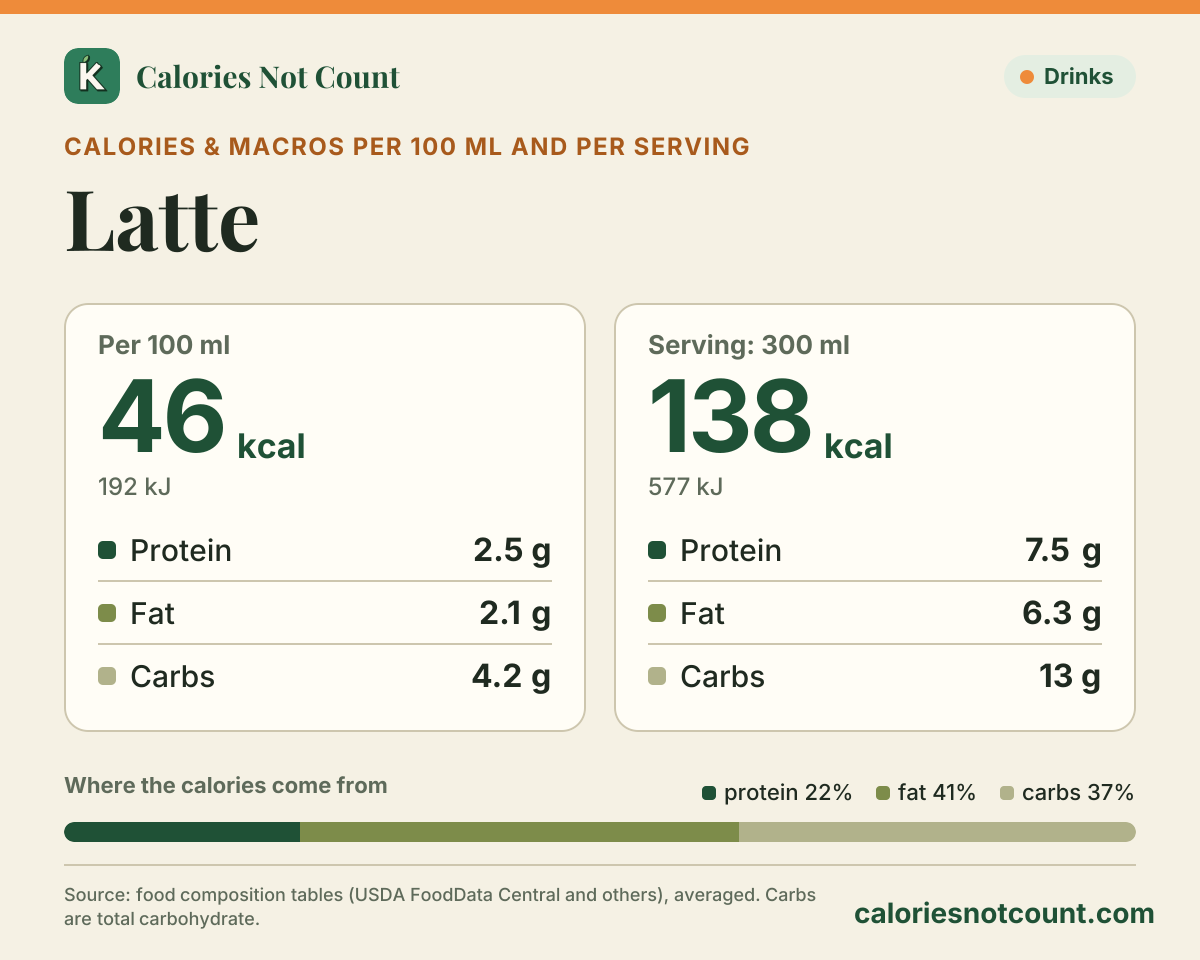
Latte nutrition facts per 100 ml and per serving
| Nutrient | Per 100 ml | Serving: 300 ml |
|---|---|---|
| Calories | 46 kcal | 138 kcal |
| Energy (kilojoules) | 192 kJ | 577 kJ |
| Protein | 2.5 g | 7.5 g |
| Fat | 2.1 g | 6.3 g |
| incl. saturated | 1.3 g | 3.9 g |
| Total carbohydrates | 4.2 g | 13 g |
| incl. sugars | 4.2 g | 13 g |
| incl. fiber | 0 g | 0 g |
| Salt | 0.1 g | 0.3 g |
*Where the numbers come from
Values per 100 ml as eaten, averaged from food composition tables (USDA FoodData Central and others) and rounded — a specific brand or recipe will differ a little. Carbohydrates are total carbohydrate, fiber included, as on a US Nutrition Facts label.
46 kcal (192 kJ) per 100 ml · P/F/C 2.5/2.1/4.2 g
Serving (300 ml) — 138 kcal (577 kJ) · Nutri-Score B
Per 100 ml: sugar: medium saturated fat: medium salt: low fiber: low
Yes. On its nutrient profile, a latte is a healthy choice: grade B on the open 2023 Nutri-Score algorithm — the best grade any drink except water can get.
For
- Protein: 7.5 g per serving — 13% of the 56 g daily reference for a 70 kg (154 lb) adult.
A typical serving is 300 ml: 138 kcal, 7.5 g protein, 6.3 g fat and 13 g carbs. Other amounts in the table.
How we judge this, and the sources
The answer comes from the food's composition, not from opinion: its Nutri-Score grade on the open 2023 algorithm, a traffic light for sugar, salt, saturated fat and fiber per 100 g, and the share of daily reference amounts in a typical serving (for salt, sugar, fiber and vegetables, those of the WHO). It rates the food's nutrient profile; it is not medical advice. Formulas, thresholds and every source are on the methodology page; last checked against the sources on November 1, 2026. The short food description was written by our language model (AI) — how we check the text.
More about this food
A latte is espresso with lots of steamed milk: some protein and calcium from the milk, and calories that climb with syrup.
protein 22%fat 41%carbs 37%
Latte calories by volume, 100–500 ml
250 ml of latte has 115 calories and 330 ml has 152. The table gives protein, fat and carbs for each amount; for any other amount, type your own into the calculator below.
| Volume | Kcal | P / F / C, g |
|---|---|---|
| 100 ml | 46 | 2.5 / 2.1 / 4.2 |
| 200 ml | 92 | 5 / 4.2 / 8.4 |
| 250 ml | 115 | 6.3 / 5.3 / 11 |
| 300 ml — typical serving | 138 | 7.5 / 6.3 / 13 |
| 330 ml | 152 | 8.3 / 6.9 / 14 |
| 500 ml | 230 | 13 / 11 / 21 |
Free to reuse with a link to the source, CC BY 4.0
Try it with your numbers
Portion → calories and macros
Pick a food and a portion.
Latte: calories by type
“Calories per 100 ml” depends on the kind: fat level, variety, what's added. Every row comes from the same database the diary uses.
| Per 100 ml | Kcal | P / F / C, g |
|---|---|---|
| Skinny latte | 29 | 2.7 / 0.1 / 4.5 |
| Almond or coconut milk latte | 30 | 0.7 / 1.4 / 3.7 |
| Soy milk latte | 37 | 2.9 / 1.6 / 3.1 |
| Oat milk latte | 43 | 0.9 / 1.5 / 7.2 |
| Latte | 46 | 2.5 / 2.1 / 4.2 |
| Flavoured syrup latte | 71 | 2.3 / 2 / 11 |
| Lavender latte | 73 | 2.4 / 2.7 / 9.8 |
| Pumpkin spice latte | 80 | 2.3 / 3.4 / 9.9 |
What else to watch
- A 300 ml serving has 13 g of sugar — 52% of the 25 g of free sugars the WHO suggests as an ideal daily limit.
How much movement is one serving?
A 300 ml serving is 138 kcal — roughly 45 min of easy walking or 17 min of cycling for a 70 kg (154 lb) person. In the diary, minutes are worked out for your weight and the activities you actually do.
Latte: swaps and alternatives
No need to swap: a latte gets grade B, the second-best of five, and nothing is in the red on the per-100 ml traffic light: sugar 4.2 g (red is over 11.25 g), saturated fat 1.3 g (over 2.5 g) and salt 0.1 g (over 0.75 g). We only suggest a swap when it fixes a real problem. How we pick swaps.
Equally good alternatives
Same food group and the same place on the plate, with a Nutri-Score grade at least as good. Figures are for 300 ml, a typical serving of latte.
| Food | Grade | Kcal | Protein, g | Fiber, g |
|---|---|---|---|---|
| Latte | B | 138 | 7.5 | 0 |
| Flat White | B | 171 | 9 | 0 |
Latte vs similar foods: calories compared
| Per 100 ml | Kcal | P / F / C, g |
|---|---|---|
| Black Coffee | 2 | 0.1 / 0 / 0.3 |
| Kombucha | 17 | 0 / 0 / 4.2 |
| Cola | 42 | 0 / 0 / 11 |
| Orange Juice | 45 | 0.7 / 0.2 / 11 |
| Latte | 46 | 2.5 / 2.1 / 4.2 |
| Kopi | 48 | 1.1 / 1.2 / 8.3 |
| Teh Tarik | 52 | 1.5 / 1.7 / 8.1 |
FAQ
How many calories are in 100 ml of latte?
100 ml of latte has 46 calories, with 2.5 g protein, 2.1 g fat and 4.2 g carbohydrates.
How many calories are in a serving of latte?
A 300 ml serving has 138 calories: 7.5 g protein, 6.3 g fat and 13 g carbs.
What are the macros of a latte?
Per 100 ml: 2.5 g protein, 4.2 g carbs and 2.1 g fat. By calories that's about 22% protein, 37% carbs and 41% fat.
How long do you have to walk to burn a serving of latte?
About 45 min of easy walking or 17 min of cycling for a 70 kg (154 lb) person — that's the 138 calories in a 300 ml serving.
How do the calories in latte change with the type?
Per 100 ml it ranges from 29 kcal (skinny latte) to 80 kcal (pumpkin spice latte); latte is in between, at 46 kcal.