Almond Butter Nutrition Facts: Calories, Vitamins & Minerals
Almond Butter nutrition facts per 100 g and per serving
| Nutrient | Per 100 g | Serving: tablespoon, 16 g |
|---|---|---|
| Calories | 614 kcal | 98 kcal |
| Energy (kilojoules) | 2,569 kJ | 411 kJ |
| Protein | 21 g | 3.4 g |
| Fat | 56 g | 8.9 g |
| incl. saturated | 4.2 g | 0.7 g |
| Total carbohydrates | 19 g | 3.1 g |
| incl. sugars | 4.4 g | 0.7 g |
| incl. fiber | 10 g | 1.6 g |
| Salt | 0 g | 0 g |
*Where the numbers come from
Values per 100 g as eaten, averaged from food composition tables (USDA FoodData Central and others) and rounded — a specific brand or recipe will differ a little. Carbohydrates are total carbohydrate, fiber included, as on a US Nutrition Facts label.
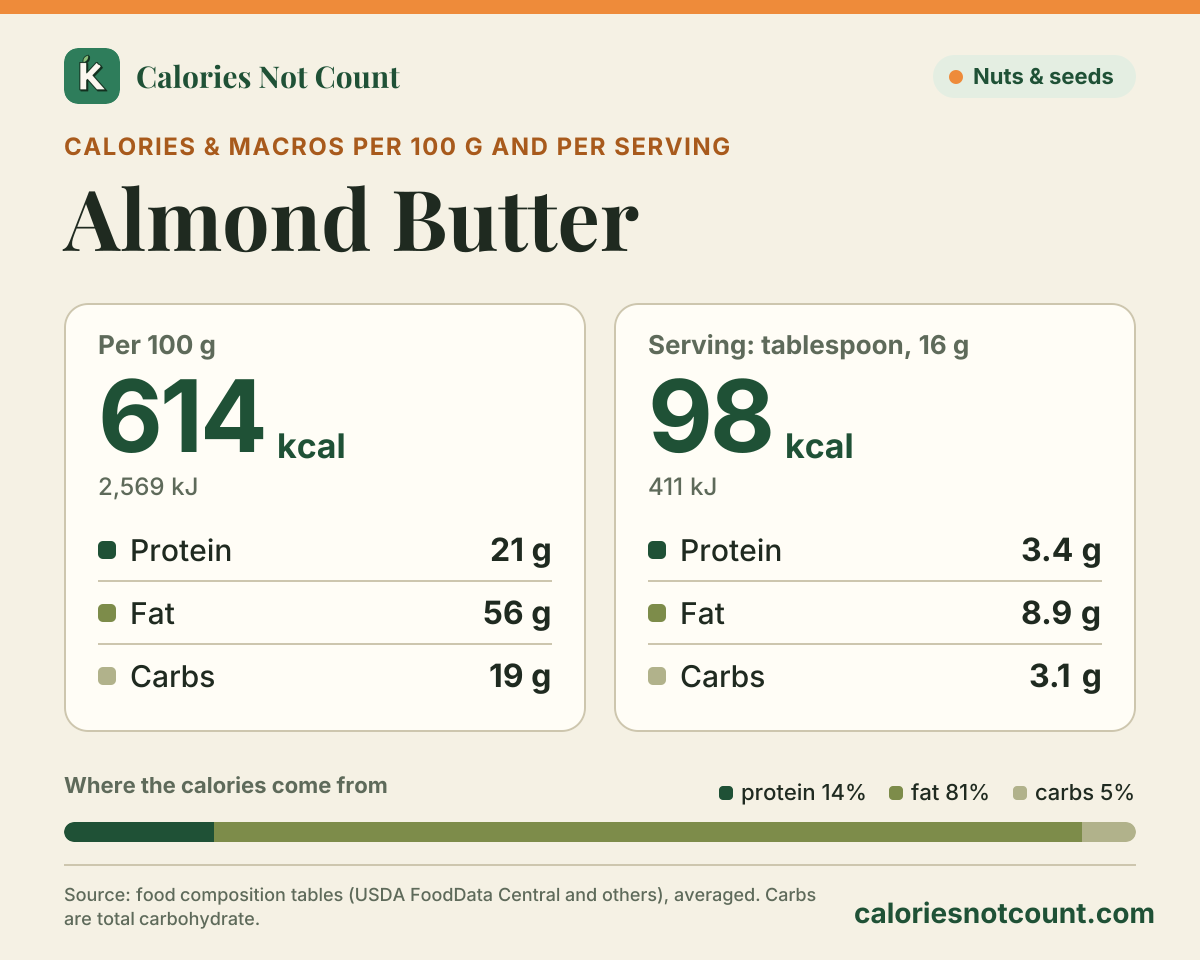
614 kcal (2,569 kJ) per 100 g · P/F/C 21/56/19 g
Serving (tablespoon, 16 g) — 98 kcal (411 kJ) · Nutri-Score A
Per 100 g: sugar: low saturated fat: medium salt: low fiber: high
Is almond butter healthy?
Yes, with an eye on the portion. On its nutrient profile, almond butter gets grade A on the open 2023 Nutri-Score algorithm, the top grade.
For
- Mostly unsaturated fat: saturated fat is 8% of the fat — 0.7 g per serving.
- Fiber: 10 g per 100 g, 1.6 g per serving.
Against
- Calorie-dense: 614 kcal per 100 g — a serving (tablespoon, 16 g) is 98 kcal.
A typical serving (tablespoon, 16 g) has 98 kcal, 3.4 g protein, 8.9 g fat and 3.1 g carbs. Other weights in the table.
How we judge this, and the sources
For oils, nuts and seeds Nutri-Score uses its own table: instead of calories it weighs the share of saturated fat in the fat, plus sugar and salt, against protein and fiber. Calories don't count against them, which is why calorie density is listed as a separate reason.
The answer comes from the food's composition, not from opinion: its Nutri-Score grade on the open 2023 algorithm, a traffic light for sugar, salt, saturated fat and fiber per 100 g, and the share of daily reference amounts in a typical serving (for salt, sugar, fiber and vegetables, those of the WHO). It rates the food's nutrient profile; it is not medical advice. Formulas, thresholds and every source are on the methodology page; last checked against the sources on November 1, 2026. The short food description was written by our language model (AI) — how we check the text.
More about this food
Almond butter is ground almonds: a bit more vitamin E and magnesium than peanut butter, a bit less protein, and nearly identical calories.
protein 14%fat 81%carbs 5%
Vitamins and minerals in almond butter
Per 100 g, the standouts are vitamin E — 24 mg, 161% of the Daily Value (#3 of 16 in our nuts & seeds section); copper — 0.93 mg, 104% of the Daily Value; manganese — 2.1 mg, 93% of the Daily Value.
| Nutrient | Per 100 g | Serving: tablespoon, 16 g | % DV |
|---|---|---|---|
| Vitamin E | 24 mg | 3.9 mg | 26% |
| Thiamin (B1) | 0.04 mg | 0.01 mg | 1% |
| Riboflavin (B2) | 0.94 mg | 0.15 mg | 12% |
| Niacin (B3) | 3.2 mg | 0.51 mg | 3% |
| Vitamin B6 | 0.1 mg | 0.02 mg | 1% |
| Folate (B9) | 53 mcg | 8.5 mcg | 2% |
| Potassium | 748 mg | 120 mg | 3% |
| Calcium | 347 mg | 56 mg | 4% |
| Magnesium | 279 mg | 45 mg | 11% |
| Phosphorus | 508 mg | 81 mg | 7% |
| Iron | 3.5 mg | 0.56 mg | 3% |
| Zinc | 3.3 mg | 0.53 mg | 5% |
| Copper | 0.93 mg | 0.15 mg | 17% |
| Manganese | 2.1 mg | 0.34 mg | 15% |
| Selenium | 2.4 mcg | 0.38 mcg | 1% |
*Where the vitamin numbers come from
Vitamins and minerals come from the USDA FoodData Central record “Nuts, almond butter, plain, without salt added” (FDC ID 168588, SR Legacy; public domain), checked October 14, 2026; the record was matched to this food by calories, protein and fat. % DV is per serving, against the FDA Daily Values used on Nutrition Facts labels (2,000-calorie diet). The table lists nutrients that reach at least 2% DV per 100 g; the rest are absent or trace. Varieties, seasons and brands differ, and cooking in water leaches some vitamin C and B vitamins.
Almond Butter calories by weight, 5–50 g
15 g of almond butter has 92 calories and 20 g has 123. The table gives protein, fat and carbs for each weight; for any other amount, type your own into the calculator below.
| Weight | Kcal | P / F / C, g | Fiber, g |
|---|---|---|---|
| 5 g | 31 | 1.1 / 2.8 / 1 | 0.5 |
| 10 g | 61 | 2.1 / 5.6 / 1.9 | 1 |
| 15 g | 92 | 3.2 / 8.3 / 2.9 | 1.5 |
| 16 g — typical serving | 98 | 3.4 / 8.9 / 3.1 | 1.6 |
| 20 g | 123 | 4.2 / 11 / 3.9 | 2.1 |
| 30 g | 184 | 6.3 / 17 / 5.8 | 3.1 |
| 50 g | 307 | 11 / 28 / 9.7 | 5.2 |
Free to reuse with a link to the source, CC BY 4.0
Calories in almond butter by spoon and serving
| Measure | Kcal | P / F / C, g |
|---|---|---|
| 1 teaspoon (5.3 g) | 33 | 1.1 / 2.9 / 1 |
| 1 tablespoon (16 g) | 98 | 3.4 / 8.9 / 3.1 |
How we count
Piece weights are averages. Spoons are level US measures: 1 tsp = 4.9 ml, 1 tbsp = 14.8 ml, 1 cup = 240 ml; the weight follows the density of the food (USDA FoodData Central measure weights). The diary uses the same measures — log a portion in pieces, spoons or grams.
Try it with your numbers
Portion → calories and macros
Pick a food and a portion.
Almond Butter: calories by type
“Calories per 100 g” depends on the kind: fat level, variety, what's added. Every row comes from the same database the diary uses.
| Per 100 g | Kcal | P / F / C, g |
|---|---|---|
| Almonds | 579 | 21 / 50 / 22 |
| Roasted salted almonds | 600 | 21 / 53 / 19 |
| Almond butter | 614 | 21 / 56 / 19 |
How much movement is one serving?
A serving (tablespoon, 16 g) is 98 kcal — roughly 32 min of easy walking or 12 min of cycling for a 70 kg (154 lb) person. In the diary, minutes are worked out for your weight and the activities you actually do.
Almond Butter: swaps and alternatives
No need to swap: almond butter already gets grade A, the top of the scale, and nothing is in the red on the per-100 g traffic light: sugar 4.4 g (red is over 22.5 g), saturated fat 4.2 g (over 5 g) and salt 0 g (over 1.5 g). We only suggest a swap when it fixes a real problem. How we pick swaps.
Equally good alternatives
Same food group and the same place on the plate, with a Nutri-Score grade at least as good. Figures are for 16 g, a typical serving of almond butter.
| Food | Grade | Kcal | Protein, g | Fiber, g |
|---|---|---|---|---|
| Almond Butter | A | 98 | 3.4 | 1.6 |
| Hazelnuts | A | 100 | 2.4 | 1.6 |
| Walnuts | A | 105 | 2.4 | 1.1 |
| Peanuts | A | 91 | 4.2 | 1.4 |
Almond Butter vs similar foods: calories compared
| Per 100 g | Kcal | P / F / C, g |
|---|---|---|
| Cashews | 553 | 18 / 44 / 30 |
| Pumpkin Seeds | 559 | 30 / 49 / 11 |
| Pistachios | 562 | 20 / 45 / 27 |
| Sunflower Seeds | 584 | 21 / 51 / 20 |
| Peanut Butter | 588 | 25 / 50 / 20 |
| Almond Butter | 614 | 21 / 56 / 19 |
| Brazil Nuts | 659 | 14 / 67 / 12 |
Almond Butter: head-to-head comparisons
FAQ
How many calories are in 100 g of almond butter?
100 g of almond butter has 614 calories, with 21 g protein, 56 g fat and 19 g carbohydrates (10 g fiber).
How many calories are in a serving of almond butter?
A serving (tablespoon, 16 g) has 98 calories: 3.4 g protein, 8.9 g fat and 3.1 g carbs.
What are the macros of almond butter?
Per 100 g: 21 g protein, 19 g carbs and 56 g fat. By calories that's about 14% protein, 5% carbs and 81% fat.
How long do you have to walk to burn a serving of almond butter?
About 32 min of easy walking or 12 min of cycling for a 70 kg (154 lb) person — that's the 98 calories in a serving (tablespoon, 16 g).
What vitamins and minerals are in almond butter?
Per 100 g, almond butter is richest in vitamin E (24 mg, 161% DV), copper (0.93 mg, 104% DV), manganese (2.1 mg, 93% DV) — from USDA FoodData Central record 168588.
How many calories are in a tablespoon of almond butter?
A level US tablespoon (14.8 ml, about 16 g) has 98 calories; a teaspoon (4.9 ml, 5.3 g) has 33.
How much fiber is in almond butter?
100 g of almond butter has 10 g of fiber; a serving (tablespoon, 16 g) has 1.6 g — 6% of the 25 g a day the WHO recommends.
How do the calories in almond butter change with the type?
Per 100 g it ranges from 579 kcal (almonds) to 614 kcal (almond butter).